
- /
Ferrari at 75: What to Look for at the 75th Pebble Beach Concours
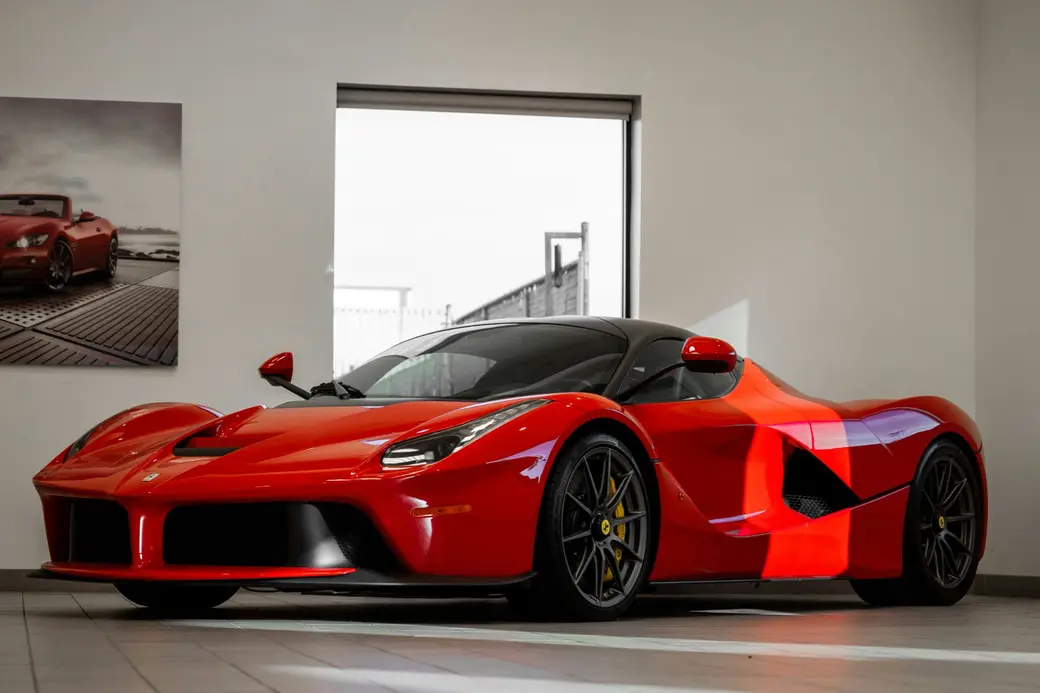
The Pebble Beach Concours d'Elegance judges roughly 175 cars across a dozen or more classes on Sunday morning. For a first-time attendee — or a regular who has not paid close attention to this year's program — the fairway can be overwhelming. There is a lot of car, and without a sense of what the program is emphasizing and why, it is easy to miss what makes a particular year's show distinctive.
The 75th Concours has a coherent theme, and understanding it before you walk the fairway makes the experience considerably richer. This post covers what the program is built around, what Ferrari's selection as the featured marque means for the cars on the lawn, and what to look for if you want to see beyond the surface.
Ferrari as Featured Marque: Why It Works for the 75th
The choice of Ferrari as the featured marque for an anniversary year is not a sentimental one. Ferrari is the marque that has appeared on the Pebble Beach lawn more often than any other, and choosing it for the 75th reflects a program that wants to dig into the full depth of what Ferrari has been rather than simply celebrate a brand that needs no introduction.
The program for this year focuses specifically on Ferrari's competition history — the factory and privateer cars that raced under the prancing horse through the 1950s and 1960s, when Ferrari's identity was defined almost entirely by what it did on the circuit. The Chinetti and NART connection is central to this story. Luigi Chinetti, Ferrari's American importer and the founder of the North American Racing Team, was responsible for bringing Ferrari's competition cars to American racing and for convincing Enzo Ferrari that the American market was worth taking seriously. The NART Spyder, the Competizione models, and the cars that carried Ferrari through endurance racing are the ones the program is built around.
The Le Mans angle is particularly relevant in an anniversary year. Ferrari won Le Mans nine times between 1949 and 1965, and the cars that did it — the 250 Testa Rossa, the 275 P, the 330 P4 — represent the peak of an era when racing results were inseparable from a manufacturer's identity. Seeing multiple examples of those cars on the same lawn at the same time is an experience that does not happen anywhere else.
Carrozzeria Alfredo Vignale: The Featured Coachbuilder
The coachbuilder spotlight at this year's Concours goes to Carrozzeria Alfredo Vignale, the Turin-based firm that produced some of the most distinctive bodywork of the postwar period. Vignale's work is less well-known than Pininfarina's or Bertone's, which makes it a genuinely interesting choice — the kind of selection that rewards close attention on the lawn.
Alfredo Vignale founded his carrozzeria in Turin in 1948, after working in the coachbuilding trade through the prewar and wartime years. The firm's output in the early 1950s was particularly distinguished: hand-formed aluminum bodies on Ferrari, Fiat, and Lancia chassis, shaped by craftsmen who worked without computer assistance or repeatable tooling. Each body was a unique object, shaped to the specific chassis it was built for.
The Vignale-bodied Ferraris from the early 1950s — the 166 Inter, the 212 Inter, the 250 Europa examples that carry his bodywork — are among the most individual and architecturally interesting cars Ferrari produced in that period. The variety of solutions Vignale's shop found for the same basic chassis, with different proportions, different greenhouse treatments, and different surface details on each car, makes a group of them together on the lawn an education in what hand coachbuilding actually meant.
The Vignale-bodied Ferraris from the early 1950s are among the most individual cars Ferrari ever produced. Each body was a unique object. No two are the same.
What to Look for When You Walk the Fairway
The Concours judging is organized into classes, and understanding which cars are competing against each other — and on what criteria — helps frame what you are seeing.
Originality vs. restoration: The Concours judges on a standard that rewards originality over restoration. A car with its original paint, original upholstery, and original mechanical components will generally outperform a beautifully restored car that has been stripped and rebuilt. The patina visible on some of the highest-scoring cars is not neglect — it is evidence of original material surviving intact. When you see a car with original paint that has aged and a car with a perfect new respray next to it, understand that the judges are looking at those two cars very differently.
The coachbuilder's hand: On the pre-1960 cars, particularly the Ferraris and the Vignale-bodied examples in the featured class, look at the panel surfaces closely. The slight irregularities in the aluminum, the way the light moves across a hand-formed surface differently than it does across a stamped panel — these are the marks of individual craftsmanship that factory production eliminated. A Vignale-bodied car from 1952 was made by a small number of people working with their hands and simple tools. The surface tells that story if you look for it.
Proportion and stance: Before reading the placard, spend thirty seconds looking at the car as a whole object. The best cars at Pebble Beach have a quality of visual rightness — the proportions work, the car sits on the ground the way it was meant to, nothing is fighting anything else. This is easier to perceive than to articulate, and it is what separates the cars that stop people from the cars that are merely excellent.
The mechanical detail: For the competition-class cars, look at the mechanical execution — the engine bay, the suspension components, the brake hardware. A racing Ferrari from 1960 was an engineering object as much as an aesthetic one, and the mechanical quality of the surviving examples reflects the extraordinary resources Ferrari devoted to the cars it sent to Le Mans. The engine bay of a 250 Testa Rossa is worth five minutes of close attention.
How Best in Show Works
The Concours Best in Show award is selected at the end of the judging day from among the class winners. Each class produces a first-place car, and those cars are then evaluated by a separate judging committee for Best in Show. The award has no predetermined class preference — a prewar Bugatti is as eligible as a 1960s Ferrari, and both are as eligible as a Depression-era American car.
What tends to win Best in Show at Pebble Beach is a car that combines exceptional originality or restoration quality with a quality of presence — the ability to hold the attention of a judging committee that has spent the entire day looking at extraordinary automobiles. The cars that win are rarely the most expensive cars on the lawn. They are almost always the ones that feel most completely themselves.
In an anniversary year with Ferrari as the featured marque, the NART and competition cars will be among the most closely watched for Best in Show consideration. A surviving factory Le Mans car in original or near-original condition, on the 18th fairway on a clear August morning with the Pacific behind it, is the kind of image the Concours has produced for 75 years. Sunday morning will produce another one.
Related reading: Car Week 2026: Your Events Guide · Life in Pebble Beach · Golf and Country Clubs in Carmel: Access, Community, and Influence
Categories
Recent Posts





GET MORE INFORMATION
